 Skip to content
Can a Philippine Consulate Authenticate a US Document for Philippine Use? (2026 Expert Guide)
Apostille | 16 January 2026 (Original Post)
Whether you are an overseas Filipino, dual citizen, foreign national, or legal practitioner, one question consistently arises when handling cross-border paperwork:
“Can a Philippine Consulate in the United States of America authenticate my document so it will be valid for official use in the Philippines?”
The answer is not a blanket yes or no.
It depends on who issued the document, where it was executed, what kind of document it is, and whether the issuing country and the Philippines are parties to the Hague Apostille Convention.
This definitive 2026 guide explains—using official Philippine and international sources—exactly:
- When a Philippine Consulate can authenticate a document
- When it cannot
- The legal difference between consular notarization, consularization, full legalization, and apostille
- How these rules apply in real-world situations involving the U.S., Canada, Europe, and the Middle East
What a Philippine Consulate Can — and Cannot — Do
A Philippine Embassy or Consulate abroad functions as an official extension of the Department of Foreign Affairs (DFA). Its authority is limited to consular acts expressly allowed under Philippine law and DFA regulations.
Core Consular Functions
A Philippine Consulate may:
- Administer oaths
- Perform consular notarization
- Certify signatures and copies executed before a consular officer
- Provide notarial and civil registry services for Filipinos overseas
These powers are reflected across official DFA and embassy service lists.
Can a Philippine Consulate Authenticate a US Document for Philippine Use?
Yes — but only in limited, specific circumstances
A Philippine Consulate can authenticate a document for Philippine use only if:
- The document is executed and signed before a Philippine consular officer, or
- The document is a private instrument (not a foreign public record) requiring acknowledgment abroad for use in the Philippines
Common Documents That Qualify
These typically include:
- Special Power of Attorney (SPA)
- Affidavits (loss, support, consent, civil status)
- Declarations and sworn statements
- Authorization letters
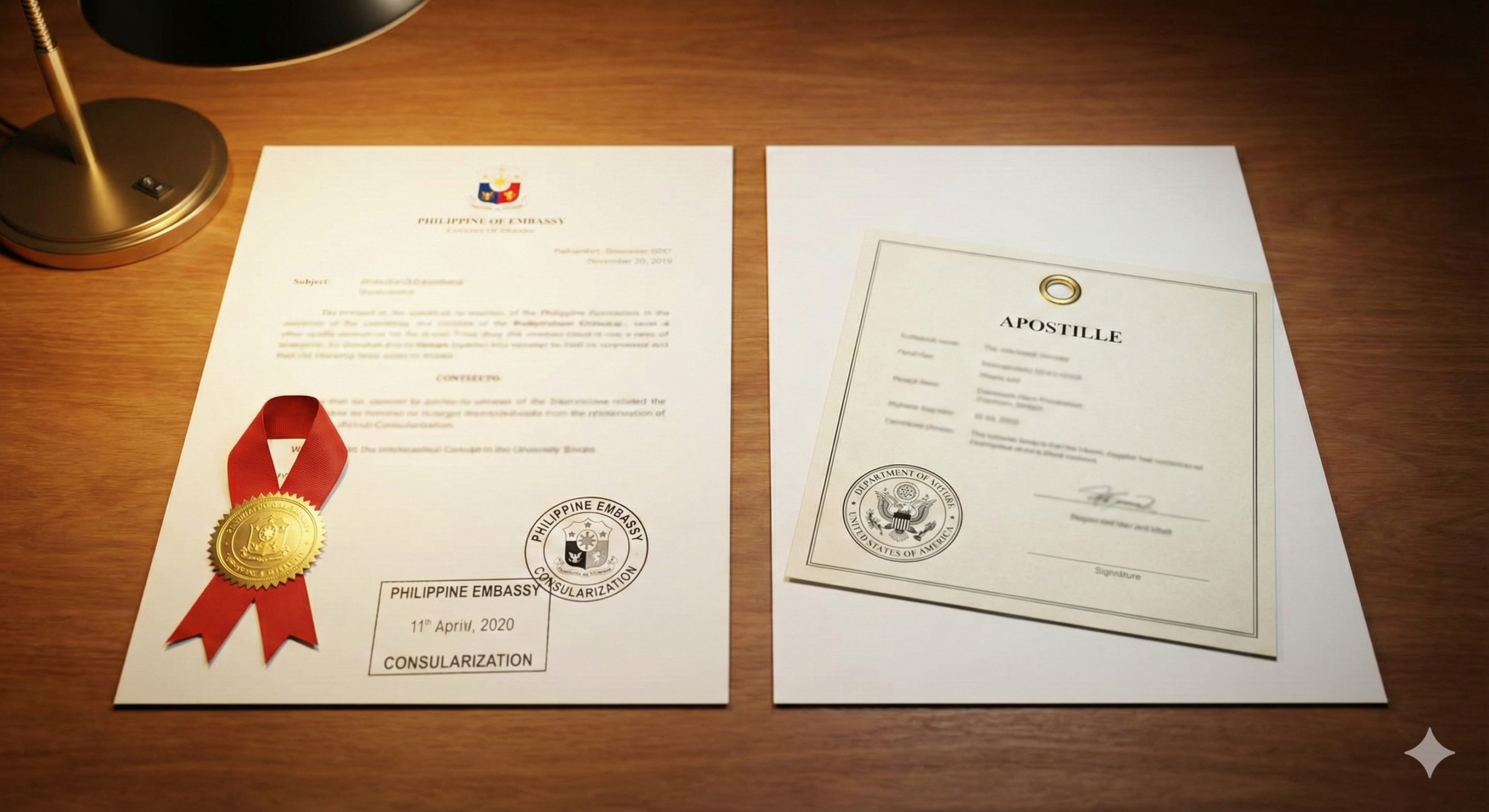
When notarized by a Philippine Consulate, these documents are treated as if notarized in the Philippines and are generally accepted by Philippine courts, registries, and government agencies without apostille.
When a Philippine Consulate Cannot Authenticate a Document
A Philippine Consulate cannot authenticate foreign public documents, including:
- Foreign birth, marriage, or death certificates
- Court orders or judgments issued abroad
- Foreign police clearances
- Academic records issued by foreign public institutions
Why This Limitation Exists
A Philippine Consulate cannot vouch for the authenticity of a foreign government’s records. It may only attest to:
- Acts performed before the consular officer, or
- Signatures personally acknowledged at the consulate
As a result, foreign public documents must be authenticated by the issuing country itself—either through apostille or full legalization, depending on treaty status.
Simple Authentication vs. Consularization vs. Full Legalization
These terms are often used interchangeably—but they are not legally the same.
1️⃣ Simple Authentication (Consular Notarization)
What it is:
A Philippine consular officer notarizes a document executed before them.
Applies to:
- Special Power of Attorney
- Affidavits
- Personal declarations
Legal effect:
- Considered notarized in the Philippines
- No apostille required for Philippine use
- This is the most common and least complicated scenario for overseas Filipinos.
2️⃣ Full Legalization (Non-Hague Countries)
What it is:
A multi-step authentication process required when the issuing country is not a member of the Hague Apostille Convention.
Typical flow:
- Authentication by the issuing authority
- Authentication by that country’s Ministry of Foreign Affairs
- Final authentication by the Philippine Consulate
Only after completing all steps is the document legally recognized in the Philippines.
3️⃣ Consularization (Often Misunderstood)
“Consularization” is not a single procedure. It is a general term used to describe the Philippine Consulate’s role in validating foreign documents as part of full legalization.
Key clarification:
- Consularization ≠ consular notarization
- Consularization applies to foreign public documents
Notarization applies to documents executed before the consulate.
Where Apostille Fits In
The Philippines is a party to the Hague Apostille Convention.
What This Means
- If a document is issued in a Hague member country, it must be apostilled in the country of origin
- Once apostilled, it is automatically recognized in the Philippines
- No consularization is required
Critical Reminder
Philippine Consulates do NOT issue apostilles for foreign documents.
Apostilles must be issued by the designated authority of the issuing country, such as the U.S. Department of State or state Secretaries of State.
USA-Specific Legal Reality
For documents issued in the United States, the determining factor is document type, not location:
✅ Consular notarization is valid for SPAs, affidavits, and declarations signed before a Philippine Consular Officer
❌ U.S. public documents (birth certificates, court orders, FBI clearances) cannot be authenticated by a Philippine Consulate
✔ These must be apostilled by:
- U.S. State Secretaries of State (state documents), or
- The U.S. Department of State (federal documents)
Because both the U.S. and the Philippines are Hague members, apostille replaces consular legalization entirely.
How This Works in Practice
Example 1 — SPA Executed Abroad
You sign an SPA before a Philippine Consular Officer in California.
✔ Consular notarization
✔ Valid in the Philippines
✔ No apostille required
Example 2 — U.S. Birth Certificate
You need a U.S. birth certificate for Philippine use.
✘ Philippine Consulate cannot authenticate
✔ Must be apostilled in the U.S.
Example 3 — Middle East Court Order
The issuing country is not a Hague member.
✔ Full legalization required
✔ Includes foreign MFA + Philippine consularization
Common Mistakes to Avoid
❌ Asking a consulate to authenticate a foreign birth certificate
❌ Assuming consular notarization replaces apostille
❌ Submitting foreign documents directly to Philippine agencies without apostille or legalization
How Apostille Pinoy Helps
Apostille Pinoy serves as a compliance layer, not just a processor. We assist by:
- Identifying the correct authentication pathway
- Guiding consular notarization when appropriate
- Managing apostille and full legalization workflows
- Reducing rejection risks for Philippine courts and agencies
Frequently Asked Questions
Q: Can Philippine Consulates authenticate foreign public documents?
No. Only documents executed before a consular officer may be authenticated.
Q: Is consular notarization valid in the Philippines without apostille?
Yes, for private documents signed before the consulate.
Q: Does the Philippine Consulate issue apostilles?
No. Apostilles are issued by the document’s country of origin.
Q: Are apostilles required for Philippine documents going abroad?
Yes, if the destination country is a Hague member.